


Editor’s note: Big news... enrollment to RiskHedge’s brand-new warrants advisory, Strategic Trader, is now open. Go here to get all the details.
Now, here’s Stephen McBride with a new original essay on the bloodbath unfolding in software stocks.
***
Hello, 9-1-1. I’d like to report a murder.
In the past few weeks, nearly $1 trillion was wiped from software stocks.
The largest software ETF—the iShares Expanded Tech-Software Sector ETF (IGV)—has cratered 24% since January.
The grandaddy of the Software-as-a-Service (SaaS) boom over the past decade, Salesforce (CRM), is down 28% this year.
It’s nice to see the market wake up to what I’ve been saying for over two years... that artificial intelligence (AI) will kill many well-known software giants.
But as I’ll show you, certain software companies with very specific qualities won’t just survive AI disruption. They’ll thrive in it.
And right now, those stocks are on sale.
- Back in November 2023 at our AI Summit in NYC…
I warned that AI would make many software business models obsolete.
I specifically called out Salesforce.
AI can easily automate most of what it does, which is selling customer relationship management (CRM) software.
Coding and programming used to be an elite “sport.” Building a customer relationship database used to take thousands of engineers years.
Now, using new AI agent tools like Claude Code, you can build your own version in a weekend.
Claude Code is a new tool from Anthropic, the company behind Claude AI. It can essentially do anything a human can on a computer. It’s like giving ChatGPT access to your mouse, keyboard, files, and internet connection.
- For the past two weeks, I’ve been a Claude Code addict.
I’ve been waking up at 4 am to use these tools. Watching it work is one of the most fun experiences I’ve had in a long time.
I’ve used it to build: a startup database… a personal “DOGE” bot to help me slash my spending… and my own medical advisor that I used to order blood tests.
And by the way, I’ve never written a single line of code in my life.
- Software ate the world, and now AI is eating software.
The entire software landscape is going through a tectonic shift.
For years, many “SaaS” companies charged premium prices for their product because writing software required tons of expensive coders.
Now you can access one of the world’s best coders (Claude Code) for $100/month, and “he” will work tirelessly for you.
|
The key insight for investors here is that revenue does not need to decline for these stocks to crash. For the past decade, these software stocks commanded huge valuations because they were growing incredibly fast.
A company priced to perfection will re-rate lower even if growth slows. That’s what we’re seeing now.
- But not all software stocks are toast…
The selloff happened. Now what?
You buy the software companies that own things AI cannot generate or scrape.
The way I see it, there are two broad “moats” for software companies in this new AI age:
- Data that is unique and private. If an AI can't get the data elsewhere, the value of this data increases.
- Regulation. Hospitals won't switch to a chatbot that isn't FDA-approved. Same for governments.
With that in mind...
- Let me introduce… the RiskHedge Software Anti-Disruption Portfolio.
Here are three companies I know won’t be disrupted by AI:
#1: CrowdStrike Holdings (CRWD)
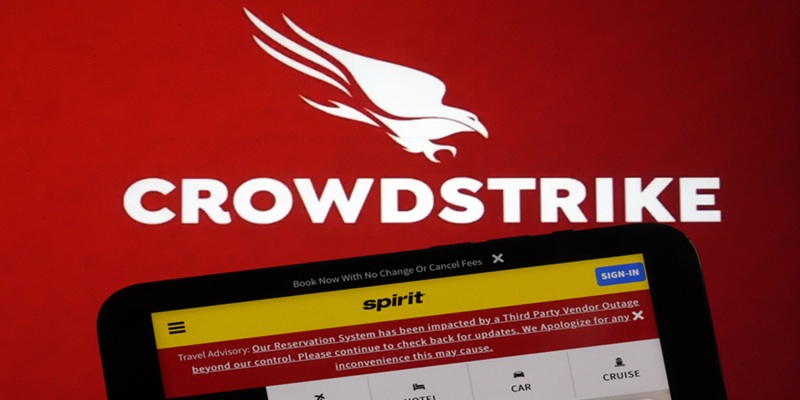
CrowdStrike observed trillions of threat events across its network. Every new attack makes its system smarter. That data is proprietary. It doesn’t live inside ChatGPT. And no serious enterprise is going to rip out a battle-tested security platform protecting billions in assets just to save a few percents on software costs.
AI makes cybersecurity more important, not less. As AI lowers the barrier to launching sophisticated attacks, the demand for advanced, data-rich defense systems increases.
#2: Palantir Technologies (PLTR)
Palantir embeds inside governments and large enterprises. It ingests decades of internal operational data—data that doesn’t exist anywhere else. When an intelligence agency or a major corporation builds its workflows around Palantir’s systems, it becomes core to their day-to-day operations.
You don't "rip and replace" software that runs a warzone, or an oilfield.
Palantir is an AI leader.
#3: Synopsys (SNPS)
You can't have AI without Nvidia (NVDA) chips. Nvidia can't design chips without Synopsys.
Every advanced chip, including the ones built by Nvidia, has to be designed before it’s manufactured.
And chip design today is unimaginably complex. We’re talking billions of transistors arranged at nanometer scale. A tiny flaw can cost hundreds of millions of dollars.
You don’t replace that with a prompt. You don’t hand the blueprint of a billion-dollar chip to an experimental AI tool and hope for the best.
As AI models demand more compute, chips are getting more complex, not less.
- The software bloodbath reminds me of the DeepSeek selloff last year…
Last February, the Chinese startup released an AI model that was just as good as ChatGPT but cost 90% less to run. AI stocks nosedived.
That panic was a buying opportunity. So too is this one, for certain stocks.
It’s time to stop treating software as a single category. It’s time to start distinguishing between companies that own something genuinely scarce that is safe from AI.
I have no idea when the selling will stop. But if you’re a long-term investor, it’s a good time to pick up the software stocks that will thrive in the AI age.
Stephen McBride
Chief Analyst, RiskHedge
PS: Did you know you can play the next stage of the AI boom with warrants, too? RiskHedge’s newest analyst John Pangere recommends one that’s trading under $1 in his report Red Hot Warrants: Four “Buy Now” Warrants With Big Potential.
They’re all easy to buy. I know, because John walked me through the process of buying warrants during our recent on-camera demo. You can watch that here.
Or go here to get straight to the details on this new advisory and report.