



Super investor Warren Buffett once wrote in his Berkshire Hathaway (BRK.B) shareholder letter...
“In baseball lingo, our performance yardstick is slugging percentage, not batting average.”
In baseball, batting average tells you how often you get a hit. Slugging percentage tells you how much damage you do when you connect. A player hitting .250 with lots of home runs can be far more valuable than one batting .320 with nothing but singles.
Chris Reilly filling in for Stephen today. What Buffett was essentially saying is that Berkshire doesn’t need to be right all the time. It simply needs to make a lot of money when it is right.
That “slugging” mindset helped Buffett make more money from investing than anyone else in history.
- That brings me to our new RiskHedge analyst, warrants expert John Pangere...
When readers ask about John’s track record in Strategic Trader, the first instinct is to ask about win rate. How often is he right?
That number is 55%.
On the surface, that doesn’t sound extraordinary.
But that’s “batting-average” thinking.
The more revealing number is this: John’s average gain is 150%.
In other words... when he’s right, he’s not grinding out little gains. He’s often capturing triple-digit moves.
Take Purple Innovation (PRPL).
Back in 2019, Purple was a growing disruptor in the mattress industry, building a direct-to-consumer brand while expanding into traditional retail. Revenue was growing. Margins were improving. It landed on John’s radar.
The stock ultimately climbed more than 400% in under two years.
The warrants rose 4,942%.
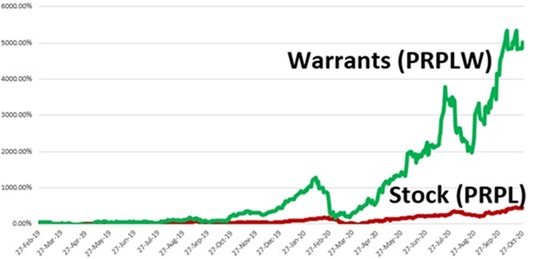
You don’t need many outcomes like that to materially improve your long-term results.
There’s the Granite Ridge Resources (GRNT) warrants, which John closed for roughly a 90% gain in about six months, even though the underlying stock was down over the same period.
Structural elements—including a cashless exchange feature and insider ownership dynamics—created an inefficiency in the warrant pricing that John was able to exploit.
Not a grand slam. But a meaningful extra-base hit.
Then there’s Intuitive Machines (LUNR), the space company tied to NASA’s Artemis program. When its Nova-C lander became the first US vehicle to softly land on the moon since 1972, investor attention followed. The warrants surged more than 150% in a matter of months.
John took a Free Ride, selling enough to recover the initial speculation, and ultimately closed the trade for a 262% gain. Another triple.
Occidental Petroleum Corp. (OXY): 1,333%
Blink Charging Co. (BLNK): 2,805%
Target Hospitality Corp. (TH): 2,174%
|
Grand slams.
When you look at the full set of closed trades, sure there are losses. Some big ones. But the whole point is the winners more than make up for them.
As John always reminds members, warrants are volatile. Never invest more money than you can afford to lose. It only takes a small amount to make a big difference in your portfolio.
- Keep in mind, I’ve only been talking about John’s closed trades in Strategic Trader.
The pattern is there in his active portfolio, too.
There are currently 26 open warrant positions in his portfolio. Eleven of them are already sitting on triple-digit gains. The average gain is 155%.
Behind the performance? John’s “T-U-V” system, which he and I discussed on Monday.
T-U-V stands for time, underlying stock, and volume.
Time matters because warrants expire. John generally looks for three to five years of runway. That window gives a company time to execute, a story time to develop, and capital time to flow in. When the runway is too short, you’re effectively betting on immediate results.
Underlying stock is where most of the work happens. John won’t buy a warrant on a company he wouldn’t consider owning outright.
Volume is important because some warrants barely trade. John avoids those and sets strict buy-up-to prices and uses limit orders so members get in at a good price.
Out of roughly 400 tradeable warrants in US markets, most fail at least one of those tests.
What remains is...
- A smaller group of high-upside opportunities for those willing to give warrants a try.
As we’ve been saying for the last couple weeks, warrants are as simple to buy as the stocks in your brokerage account.
They also require less upfront capital and provide leverage to the underlying stock. Meaning when the stock moves an inch, the warrant can move a mile, as you saw with Purple Innovation.
There’s still time (but not much) to claim your Charter Membership to Strategic Trader.
When you join, you’ll get John’s Playbook, Master Course, and top warrants to buy now.
He’ll walk you through everything.
Chris Reilly
Executive Editor, RiskHedge